Life Starts at 40
This post is heavily influenced by the talk Life Begins at 40 by Professor Mark Jackson.
“There is something rather extraordinary that happens to a person around the age of 40… they wake up… with a quiet recognition that everything they thought was important… simply is not.” — Alan Watts
My wife and I sometimes talk about if we would go back to any other time in our lives. We always end up saying no, which I think even surprises us at first. Youth is just so celebrated in pop culture. It would certainly make sense for us to go back to a time when we were more athletic, more free, more whatever. Even the language around that paints a picture of decline.
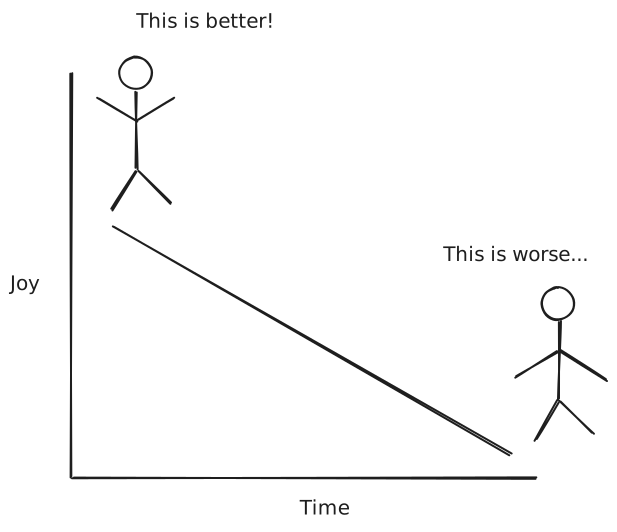
The reason I wouldn’t go back to any time before now is because I can still remember the discomfort I felt from not knowing who I was. I had so much drive to become something. I just didn’t know what that was. I didn’t even have a clue what the world needed! Even when I was 30, I would wonder if I was on the right path as if there was some sort of right path.
That created a ton of anxiety! Growing up is just taking one hopefully directionally correct step after another while the fog of war obscures where we will actually will end up.
Hopefully this degree will pay off!
Hopefully I can pay off this debt!
People tell you to just trust the process which somehow makes everything worse. You mean the process of buying your first house at 22 on a minimum wage job? You mean the process that is wildly inaccessible to the people that you are telling to trust it?
Then comes 40
For some reason, around 40 many people stop wondering what they will become and turn their attention inward to who they have become. Not that they are done growing or going anywhere, but they finally start to have an opinion about where they are presently standing. They take a minute to look around and that is when panic ensues.
The View from the Top
The first scary thing that everyone notices is that when you have spent 20 years of your life in education and 20 more using that big brain you made to actually do something is that now you have an identity! I mean, you did before, but not really. Being a high school student or a college kid is not an identity. Working your first job isn’t your identity. The first people you dated in your teens and 20s and maybe even 30s dated a completely different person than you are now as you stare into mid-life.
The second scary thing they notice as they take a look around is that no matter what direction they look, every direction is down. Looking to the past they see their younger self trading precious time to climb to their current location. Looking to the future, they see their inevitable physical decline and inescapable death.
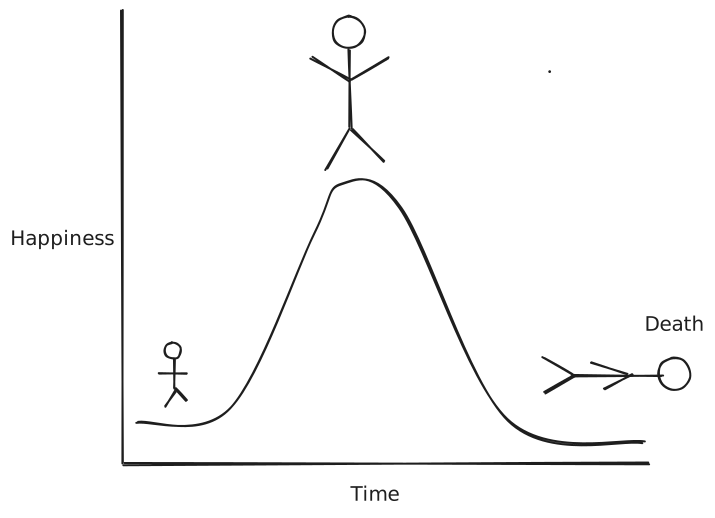
Pretty bleak.
Lashing out
So what to do??? Bad things, usually.
The first step in accepting the place on your mountaintop is denial. I can’t speak for women, but men tend to exhibit manic behavior to prove that they are not in decline. The old joke was that they would just cheat on their wife and buy a sports car, but millennials can’t afford sports cars! The previous generation did such a good job bankrupting the social structures meant to help the middle class that now no one can afford an affair or Corvette. Social media says men have two choices now: world history or smoking meat. Both of those also include a healthy dose of alcoholism.
Even worse, men sometimes like to blame other people for the parts of the mountaintop that they don’t like! Social media and predatory news channels love weaponizing unfocused anger. Maybe… immigrants took the job you deserved. Maybe it is those gosh darn minorities that moved into your county that never actually ate the pets you thought they ate.
Or maybe the call is coming from inside the house! Maybe it is your wife that is preventing you from living the life you want. In Elliott Jaques book Death and the mid-life Crisis, he states:
“The compulsive attempts… to remain young, the hypochondriacal concern over health and appearance the emergence of sexual promiscuity in order to prove youth and potency the hollowness and lack of genuine enjoyment of life… are familiar patterns. They are attempts at a race against time.” Elliott Jaques, “Death and the mid-life crisis” (1965)
Why in the world this happens
No one really knows which is why it is fun to talk about. Some say it is psychological: another identity crisis just like adolescence. Maybe high school was great, but you went from being captain of the team to pushing shopping carts. Maybe high school was awful, but you now find yourself in a position where many people are depending on your work or guidance. Either way, you are no longer who you were and thus feel lost.
Some say it is physical: you are starting to get some grays and every time you look in the mirror, you see the runaway train that is aging. You aren’t as strong, you aren’t energetic, and you can hardly stay up past 9:00 PM.
Some say it is cultural. In the 1970s, Bernice Neugarten introduced the concept of the timeline of life.
Born, marry, have kids, die
Now people have a stick to measure themselves against! Who is right? Me or Mrs. Jones who is just so annoyingly perfect all the time! I mean, who smiles that much?
No matter what, it is a Paradox
And that paradox is that you have climbed your butt off to get where you are and one day you will die. So by definition, you are at the top of life mountain. Now that you finally know things and still have some fight in you, you are the most dangerous you will ever be, but you feel like you are halfway dead. You just have the wrong chart! It is amazing what the right chart can do.
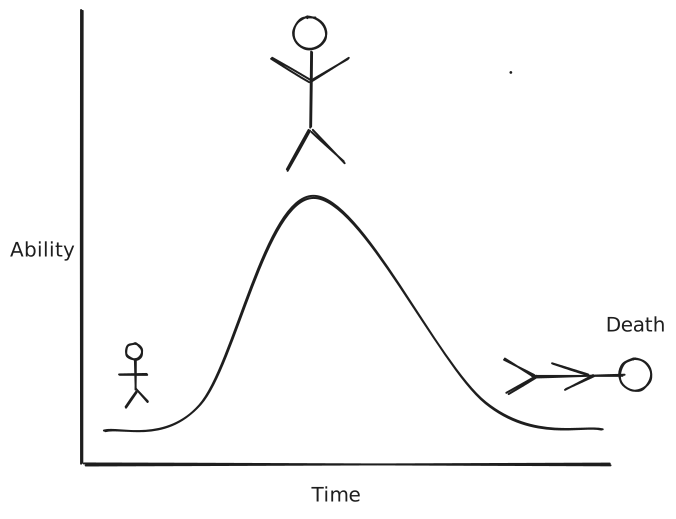
Wait, isn’t that the same chart? No man. Look at the Y axis. This one says ability and the previous one says happiness. You are not halfway through life. You are the most badass you will ever be!
What to do about it!
Widen the peak
Well Ryan, that decline still looks pretty crappy. I have yet to really feel good about this very temporary mountain that I am standing on.
That is fair. Let’s get some inspiration from women. “Life begins at 40” was first used in 1917 by Mrs Theodore Parsons. On the surface, maybe it seems like she was just trying to make herself feel better about being 40, but the context of her statement is awesome! It was a call to action to her fellow women!
During WWI, so many men were involved in the war that she thought women needed to be mentally and physically strong to take care of the country while so many men were gone. She said:
“It is a paradox of life that we do not begin to live until we begin to die. Death begins at thirty that is, deterioration of the muscle cells sets in. Most old age is premature, and attention to diet and exercise would enable men and women to live a great deal longer than they do today. The best part of a woman’s life begins at 40.” — Mrs. Theodore Parsons.
You go Mrs. Parsons!
What she is saying we should do is foundational to doing anything in midlife. You need to be mentally and physically strong enough to actually do the thing! So thanks to Mrs. Parsons we know our foundational first step to living a kick-ass life after 40: widen the top of the mountain.
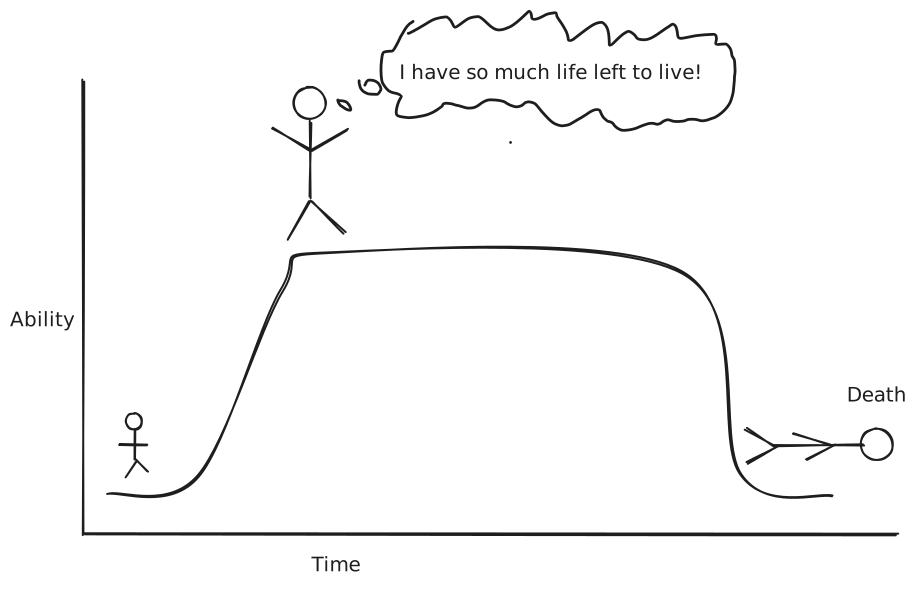
To do what though?
Enter Erik Erikson. This guy came up with The Stages of Psychological Development. We won’t go over what those are, but this blog focuses on Stage 7 which he unforgivingly calls Middle Age and defines it as Generativity vs. Stagnation. It is also depressingly, his second-to-last stage. However, it is the longest, from 40-65 and that is if you don’t extend the top of the curve like Mrs. Parsons.
The conflict he highlights is between generativity and stagnation.
Generativity: those who feel they are making valuable contributions, for instance through raising children or improving society, develop a sense of generativity. This involves concern for others and a desire to contribute to future generations, often through parenting, mentoring, leadership, or creative work that adds value to society..
This is making your mark on the world! That might be giving a kid the life you always wanted or it might be creating something that the world needs that will outlast you, but it is your thing! You are working towards something greater than yourself!
Stagnation: those who feel they are not making a positive impact or are not involved in productive or creative tasks, they may experience stagnation. Stagnation involves feeling unproductive and uninvolved, leading to self-absorption, lack of growth, and feelings of emptiness.
I think stagnation is when people do not transition out of the previous phase. In high school and college, people are pouring hours into you to make you better. They are giving to you. Eventually, it is your turn to give to the world and not doing it feels like you are wasting the energy of all of those people who have put their time into you whether that be parents, teachers, coaches, whatever.
Do you owe the world anything? Nah. Those people would have done it anyway because that is who they were. Now you get to look around from the top of your mountain, as wide or as narrow as it may be, and decide who you are and what you are going to give to the world.
And the best part is the more you give, the happier you will be.